
Learning & HR Tech Glossary
Plain-language definitions of the enterprise learning and HR-technology terms that matter most — from LMS and LXP to SCORM, xAPI, competency frameworks and India-specific compliance like POSH and DPDP, plus Violetinfo.ai's proprietary AI learning frameworks.
Core Learning & HR Tech Terms
- Learning Management System (LMS)
- A Learning Management System (LMS) is software that delivers, tracks and reports on structured training and compliance learning for an organization.
- Learning Experience Platform (LXP)
- A Learning Experience Platform (LXP) is a learner-centric system that uses AI to recommend personalized, self-directed learning content.
- SCORM
- SCORM (Sharable Content Object Reference Model) is a technical standard that lets e-learning content work across any compliant LMS.
- xAPI (Experience API)
- xAPI is a learning data standard that records a wide range of learning experiences, including offline and informal activity, as “statements.”
- Competency Framework
- A competency framework is a structured model of the skills, knowledge and behaviors required for roles across an organization.
- Microlearning
- Microlearning delivers training in short, focused units — typically a few minutes — designed for quick consumption and retention.
- Blended Learning
- Blended learning combines online digital learning with in-person or live instruction in a single program.
- AI Tutor
- An AI tutor is a software assistant that provides personalized, conversational guidance and answers to learners in real time.
- Compliance Training
- Compliance training educates employees on laws, regulations and policies they must follow, with tracking and evidence for audits.
- POSH (Prevention of Sexual Harassment)
- POSH refers to India’s Prevention of Sexual Harassment at Workplace Act, 2013, which mandates employee awareness training and reporting mechanisms.
- DPDP (Digital Personal Data Protection)
- DPDP refers to India’s Digital Personal Data Protection Act, 2023, governing how organizations collect, process and protect personal data.
- Employee Onboarding
- Onboarding is the process of integrating new hires into an organization, from pre-joining through their first months, to reach productivity faster.
- Upskilling
- Upskilling is teaching employees new or advanced skills to perform their current roles better as requirements evolve.
- Reskilling
- Reskilling is training employees to take on a different role, typically as existing roles change or are automated.
- Skills Gap Analysis
- Skills gap analysis compares the skills a workforce has against the skills it needs, to prioritize hiring and development.
- Learning Analytics
- Learning analytics is the measurement and analysis of learner data to improve learning outcomes and demonstrate impact.
- Gamification
- Gamification applies game elements — points, badges, leaderboards and streaks — to learning to boost motivation and engagement.
- Adaptive Learning
- Adaptive learning uses technology to adjust content, pace and difficulty in real time based on each learner’s performance.
- Mobile Learning
- Mobile learning (m-learning) delivers training on smartphones and tablets, enabling learning anytime, anywhere, including offline.
- Knowledge Management
- Knowledge management is the practice of capturing, organizing and sharing organizational knowledge so the right information reaches the right people.
- Learning Content Management System (LCMS)
- A Learning Content Management System (LCMS) is software for creating, storing, reusing and managing learning content from a single repository.
- Course Authoring Tool
- A course authoring tool is software used to create digital learning content such as courses, assessments and interactive modules.
- Instructor-Led Training (ILT)
- Instructor-led training (ILT) is training delivered in person by a trainer to a group of learners, typically in a classroom setting.
- Virtual Instructor-Led Training (VILT)
- Virtual instructor-led training (VILT) is live, trainer-led training delivered remotely over video conferencing tools.
- Social Learning
- Social learning is learning that happens through interaction with others — discussion, collaboration, observation and shared knowledge.
- Learning Path
- A learning path is a structured sequence of courses and activities that guides a learner toward a specific role, skill or goal.
- Certification Management
- Certification management is the process of issuing, tracking and renewing the certifications employees must hold to perform regulated or skilled roles.
- Learning Record Store (LRS)
- A Learning Record Store (LRS) is a database that collects and stores learning activity data captured as xAPI statements.
- cmi5
- cmi5 is a modern e-learning standard that combines the structure of SCORM with the rich tracking of xAPI.
- Single Sign-On (SSO)
- Single sign-on (SSO) lets users access multiple applications, including the LMS, with one set of login credentials.
- Learning Tools Interoperability (LTI)
- Learning Tools Interoperability (LTI) is a standard that lets external learning tools and content integrate seamlessly with an LMS.
- Training Needs Analysis (TNA)
- Training needs analysis (TNA) is the process of identifying the gaps between current and required skills to plan effective training.
- Extended Enterprise Learning
- Extended enterprise learning is training delivered to external audiences such as customers, partners, vendors and distributors.
- Deskless Workforce
- The deskless workforce is the majority of workers who do their jobs away from a desk or computer — on factory floors, in the field, in stores or on the move.
- Just-in-Time Learning
- Just-in-time learning delivers short, relevant content to employees exactly when they need it to perform a task.
- Performance Support
- Performance support provides on-demand guidance and resources that help employees complete tasks correctly in the flow of work.
- Content Curation
- Content curation is the process of selecting, organizing and recommending the most relevant learning content from many sources.
- Skills Taxonomy
- A skills taxonomy is a structured, organized list of the skills an organization recognizes, with relationships between them.
- Digital Badges
- Digital badges are verifiable online credentials that recognize a specific skill, achievement or completed learning.
- Learning in the Flow of Work
- Learning in the flow of work means embedding learning into daily tasks and tools rather than treating it as a separate activity.
- Cohort-Based Learning
- Cohort-based learning is a model where a group of learners progresses through a program together over a set period.
- Generative AI in Learning
- Generative AI in learning uses AI models to create content, assessments, summaries and personalized guidance for training.
- Instructional Design
- Instructional design is the practice of creating effective learning experiences by applying evidence-based learning principles.
- ADDIE Model
- ADDIE is an instructional design framework with five phases: Analysis, Design, Development, Implementation and Evaluation.
- Kirkpatrick Model
- The Kirkpatrick model evaluates training effectiveness across four levels: Reaction, Learning, Behavior and Results.
- Learning ROI
- Learning ROI measures the business return generated by training relative to its cost.
- MOOC (Massive Open Online Course)
- A MOOC is an online course designed for large-scale, open participation, typically delivered over the internet to many learners at once.
- Online Proctoring
- Online proctoring uses technology to monitor and verify the integrity of assessments taken remotely.
- Data Residency
- Data residency refers to where an organization’s data is physically stored and the legal jurisdiction that governs it.
- ISO 27001
- ISO 27001 is an international standard for information security management systems (ISMS).
- SOC 2
- SOC 2 is an auditing standard that reports on how a service organization manages data security, availability and privacy.
- Talent Management
- Talent management is the integrated set of HR practices for attracting, developing, retaining and deploying employees.
- Succession Planning
- Succession planning is the process of identifying and developing employees to fill key roles in the future.
Standards & Interoperability
- Tin Can API
- Tin Can API is the original name for xAPI, a specification that records learning experiences as activity statements across systems.
- AICC
- AICC is an early e-learning interoperability standard that defined how courses and LMS platforms communicate, predating SCORM.
Learning Models & Modalities
- Vernacular Learning
- Vernacular learning is training delivered in learners’ regional or native languages rather than only in English.
- Self-Paced Learning
- Self-paced learning lets learners progress through content on their own schedule, without fixed class times or instructor pacing.
- Learning Journey
- A learning journey is a structured, sequenced set of learning experiences designed to move a learner toward a defined goal over time.
- Learning Ecosystem
- A learning ecosystem is the connected set of technologies, content, people and processes that support learning across an organization.
- Learning Reinforcement
- Learning reinforcement uses follow-up activities such as spaced repetition and refreshers to strengthen retention after initial training.
Assessments
- Knowledge Check
- A knowledge check is a brief, low-stakes question or set of questions used to confirm understanding during or after learning.
- Assessment Engine
- An assessment engine is the software component that creates, delivers, scores and reports on tests and quizzes within a learning platform.
Gamification
- Leaderboard
- A leaderboard is a ranked display of learners based on points, completions or other metrics, used to encourage participation.
Learning Analytics & Metrics
- Learning Adoption
- Learning adoption measures how widely and consistently employees take up and use available learning programs and platforms.
- Learning Engagement
- Learning engagement measures how actively learners interact with content, including participation, time spent and completion behavior.
- Learning Effectiveness
- Learning effectiveness measures whether training achieves its intended outcomes, such as knowledge gain, behavior change or performance improvement.
Learning Metrics & KPIs
- Course Completion Rate
- The percentage of enrolled learners who finish a course relative to the total number who started or were assigned to it.
- Learning Adoption Rate
- The proportion of eligible employees who actively use the learning platform relative to the total population invited or licensed.
- Average Learning Hours
- The mean amount of time learners spend on learning activities over a defined period, usually per learner.
- Active Learners
- The count of individuals who have engaged in at least one qualifying learning activity within a defined time period.
- Monthly Active Learners
- The number of unique individuals who engaged in at least one qualifying learning activity within a calendar month.
- Time to Competency
- The elapsed time it takes a learner to reach a defined level of proficiency in a skill or role after beginning training.
- Knowledge Retention Rate
- The degree to which learners retain knowledge or skills over time after completing a learning activity.
- Certification Pass Rate
- The percentage of learners who pass a certification assessment relative to the total number who attempted it.
- Skill Readiness Score
- A composite measure of how prepared an individual or team is to perform the skills required for a role or objective.
- Engagement Index
- A composite metric summarizing the depth and breadth of learner interaction with learning content and activities.
- Content Consumption Rate
- The rate at which learners access and progress through available learning content over a defined period.
- Learning Velocity
- The pace at which learners progress through learning content or acquire skills over a given period.
- Learning Consistency Score
- A measure of how regularly and evenly a learner engages in learning activity over time rather than in sporadic bursts.
- Learning Habit Score
- A measure of how ingrained and recurring an individual's learning behavior has become over time.
- Technical vs Non-Technical Learning Ratio
- The proportion of learning activity devoted to technical skills relative to non-technical or soft skills.
- Learning Frequency Index
- A measure of how often learners engage in learning activity across a defined period.
- Learning Streak
- The number of consecutive periods, such as days or weeks, in which a learner sustains qualifying learning activity.
- Skill Gap Index
- A measure of the difference between the skills a workforce currently possesses and the skills it requires.
- Learning Maturity Index
- A composite measure of how developed and embedded an organization's learning culture and capability are.
AI in Learning
- Learning Copilot
- An AI assistant embedded in a learning platform that helps learners find content, answer questions, and complete tasks in context.
- AI Mentor
- An AI system that provides ongoing guidance, encouragement, and developmental advice to support a learner's long-term growth.
- AI Coach
- An AI tool that gives learners targeted feedback and practice to improve specific skills or behaviours.
- Agentic Learning
- An approach where AI agents take autonomous actions to plan, sequence, and support a learner's path toward a goal.
- Autonomous Learning
- Self-directed learning in which the learner sets goals and pace, often supported by AI that adapts to their choices.
- Conversational Learning
- Learning that takes place through natural-language dialogue with an AI system rather than static content.
- Learning Recommendation Engine
- A system that suggests relevant courses or content to learners based on their profile, behaviour, and goals.
- Learning Graph
- A structured map of learning content, skills, and their relationships used to guide pathways and recommendations.
- Knowledge Graph
- A network of entities and their relationships that lets AI systems reason over connected information.
- Learning Persona
- A representative profile that captures a learner segment's goals, preferences, and behaviour to guide personalization.
- Learning Behaviour Model
- A data model that captures how learners interact with content to inform personalization and predictions.
- Predictive Learning Analytics
- The use of historical learning data and statistical models to forecast outcomes such as completion or risk of dropout.
- Learning Experience Intelligence
- The analysis of learner experience data to understand engagement, satisfaction, and effectiveness across a platform.
- Skills Intelligence
- The use of data and AI to map, measure, and forecast the skills present and needed within a workforce.
- Workforce Intelligence
- The analysis of workforce data to inform decisions about talent, skills, capacity, and organizational planning.
- Learning Orchestration
- The coordination of content, activities, and systems to deliver a coherent, timely learning experience across channels.
- Hyper-Personalized Learning
- Learning experiences tailored to the individual in real time using detailed data on their needs, behaviour, and context.
- Learning Assistant
- An AI tool that helps learners by answering questions, locating resources, and supporting tasks during learning.
- Learning Companion
- An AI presence that accompanies a learner over time, offering support, motivation, and continuity across their journey.
- Performance Support AI
- AI that delivers just-in-time guidance and answers at the moment of need within the flow of work.
Proprietary Frameworks
- AIC™Proprietary
- Violetinfo.ai's proprietary framework for designing courses that AI can consume, adapt and extend rather than treating content as static.
- AILP™Proprietary
- Violetinfo.ai's proprietary AI Learning Path framework that generates and continuously adapts each learner's route through content.
- JITL™Proprietary
- Violetinfo.ai's proprietary Just-In-Time Learning Framework for delivering the right learning at the exact moment of need.
- VCoach™Proprietary
- Violetinfo.ai's proprietary AI Learning Coach framework that guides, nudges and supports learners throughout their journey.
- Learner DNA™Proprietary
- Violetinfo.ai's proprietary behavioural learning fingerprint that captures how each individual learns.
- AI Learner Diagnosis™Proprietary
- Violetinfo.ai's proprietary diagnostic framework that analyses learner behaviour to identify gaps and barriers to progress.
- Learning DNA Report™Proprietary
- Violetinfo.ai's proprietary personalized report that summarises a learner's Learner DNA™ in a clear, shareable profile.
- Cloud of Learning™Proprietary
- Violetinfo.ai's proprietary concept for aggregating every learning source into one connected, intelligent ecosystem.
- Learning Intelligence Layer™Proprietary
- Violetinfo.ai's proprietary AI intelligence framework that sits across the LMS and LXP to add analysis and adaptation.
- Learning Health Index™Proprietary
- Violetinfo.ai's proprietary composite score that measures the overall health of learning for a learner or organisation.
- Learning Intelligence Score™Proprietary
- Violetinfo.ai's proprietary indicator of learner maturity, reflecting how effectively an individual learns and applies knowledge.
- VPath™Proprietary
- Violetinfo.ai's proprietary concept for AI-guided collaborative learning journeys shared across a group or team.
- AI Readiness Diagnostic™Proprietary
- Violetinfo.ai's proprietary framework for assessing an organisation's readiness to adopt AI in learning.
- Compliance Audit Readiness Kit™Proprietary
- Violetinfo.ai's proprietary methodology for preparing learning and compliance records ahead of an audit.
- 30-Day Learner Engagement Sprint™Proprietary
- Violetinfo.ai's proprietary 30-day framework for accelerating learner adoption and engagement.
- 90-Day ROI Visibility Promise™Proprietary
- Violetinfo.ai's proprietary framework for making the business impact of learning visible within 90 days.
Violet Products
- Adaptive Learning AI™Violet
- Violetinfo.ai's AI-driven personalization engine that dynamically adapts learning content, pace and difficulty to each learner.
- VAuthor AI™Violet
- Violetinfo.ai's AI content authoring platform that converts source material into courses, assessments and media.
- VGen AI™Violet
- Violetinfo.ai's AI bot-building and generative media framework for creating interactive learning assets.
- VSearch AI™Violet
- Violetinfo.ai's AI-powered learning search that helps users find relevant content across the entire ecosystem.
- VInsights AI™Violet
- Violetinfo.ai's AI analytics platform that turns learning and talent data into actionable insight.
- VElevate AI™Violet
- Violetinfo.ai's performance-improvement AI that connects learning activity to on-the-job performance.
- VConverse AI™Violet
- Violetinfo.ai's conversational learning AI that acts as an interactive AI tutor for learners.
- VTranslate AI™Violet
- Violetinfo.ai's AI localisation and translation framework for multilingual and vernacular learning.
- VTest AI™Violet
- Violetinfo.ai's AI-powered assessment framework featuring adaptive difficulty and proctoring.
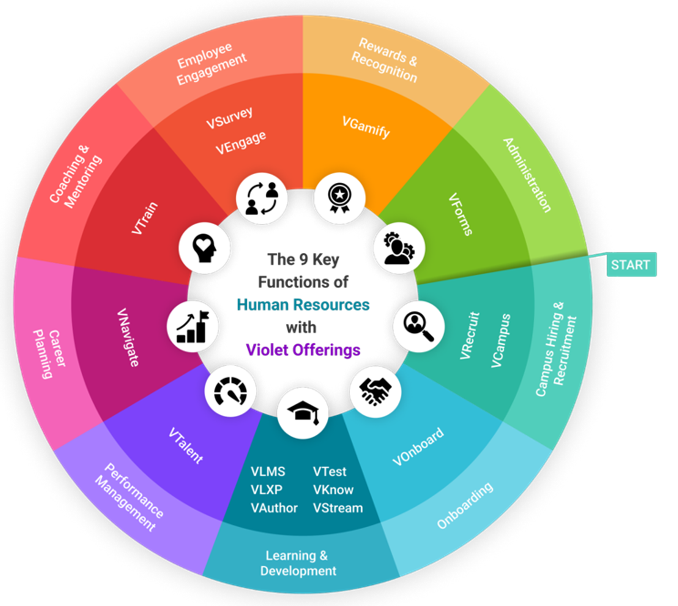
- VGamify™Violet
- Violetinfo.ai's gamification engine delivering points, badges, leaderboards and streaks to drive engagement.
- Violet Learning Intelligence™Violet
- Violetinfo.ai's overarching learning-intelligence framework that unifies its AI products across the suite.