
Instructional Design
Instructional design is the practice of creating effective learning experiences by applying evidence-based learning principles.
Instructional design is the systematic creation of learning (defining objectives, structuring content, choosing methods and assessments) so that learners actually acquire and apply the intended skills and knowledge.
It draws on learning science and models such as ADDIE and Bloom’s taxonomy, and increasingly pairs human designers with AI tools that accelerate production.
How Instructional Design works in Violetinfo.ai
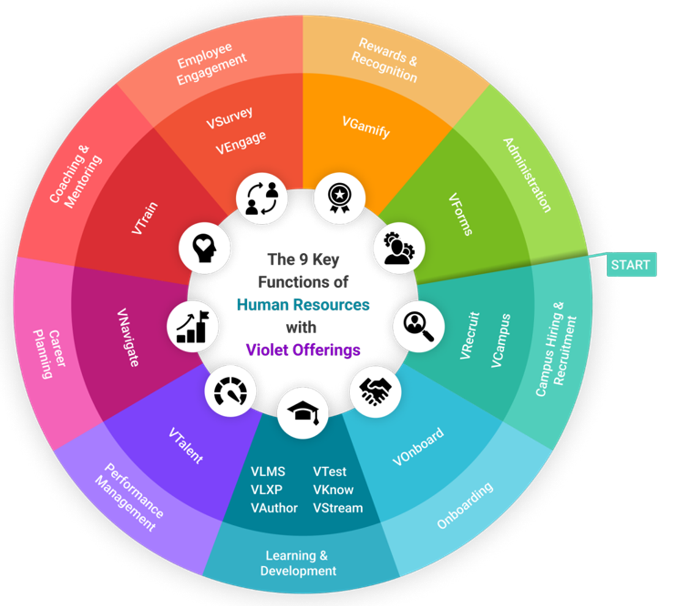
Violetinfo.ai supports instructional design with AI authoring and templates in VAuthor, helping teams turn objectives into well-structured, assessable learning faster.
Why instructional design matters for enterprise training
Large organizations spend significant time and budget on training, and much of it fails for a simple reason: content is assembled around what subject matter experts know rather than what learners need to do. Instructional design closes that gap by starting from the performance the business needs and working backward to the learning that will produce it.
For L&D and HR leaders, good instructional design also creates consistency. When every program is built on clear objectives, a logical structure and aligned assessments, courses become easier to maintain, translate, update and evaluate across regions and business units.
Core building blocks of an instructionally sound course
Most well designed courses share the same elements. Measurable learning objectives describe what the learner will be able to do after training, often written with action verbs drawn from Bloom's taxonomy (remember, understand, apply, analyze, evaluate and create in the revised version). Content is then chunked and sequenced so that each step builds on the last.
Practice activities give learners a chance to try the skill in a realistic context, and feedback tells them how they did. Assessments are written to match the objectives directly, so a course that promises applied skills tests application, not just recall. Finally, the design considers the delivery format: live sessions, self-paced eLearning, microlearning, simulations or a blend.
Common instructional design mistakes
The most frequent mistake is treating information as instruction. A slide deck converted into an online module may be complete, but without practice, feedback and relevance to the job it rarely changes performance. Another is skipping analysis and building training for a problem that is really caused by unclear processes, poor tools or missing incentives.
Teams also tend to overload courses with content that is nice to know, which increases seat time without improving outcomes. Assessments that only test memory, and objectives that cannot be measured, make it impossible to show whether the program worked.
Instructional design models and how AI fits in
Designers usually work within a process model. ADDIE (Analysis, Design, Development, Implementation, Evaluation) is the most widely known, while iterative approaches such as the Successive Approximation Model favor rapid prototypes and repeated review. Frameworks such as Gagne's Nine Events of Instruction guide how individual lessons are structured.
Generative AI tools now help designers draft outlines, scripts, scenarios and quiz questions far faster. The designer's judgment remains essential: deciding what matters, checking accuracy, and making sure the experience reflects how people actually learn.
Frequently asked questions
What does an instructional designer do?
An instructional designer analyzes a learning need, defines objectives and designs the content, activities and assessments that help learners reach them. They often work with subject matter experts, developers and business stakeholders, and they evaluate results to improve the course over time.
Is instructional design the same as eLearning development?
No, instructional design is the planning and structuring of learning, while eLearning development is the production of the digital course itself. In smaller teams one person may do both, but design decisions about objectives, sequence and assessment come before building screens or media.
Can AI replace instructional designers?
No, AI can speed up drafting and production, but it does not replace the analysis, judgment and quality review that instructional designers provide. Generative AI output still needs a person to confirm accuracy, relevance to the audience and alignment with the learning objectives.