
Learning Content Management System (LCMS)
A Learning Content Management System (LCMS) is software for creating, storing, reusing and managing learning content from a single repository.
A Learning Content Management System (LCMS) focuses on the content side of learning: authoring, versioning, storing and reusing learning objects. Where an LMS delivers and tracks courses, an LCMS manages the building blocks those courses are made from.
An LCMS lets teams create content once and reuse it across many courses and audiences, keeping a single source of truth so updates propagate everywhere the content is used.
How Learning Content Management System works in Violetinfo.ai
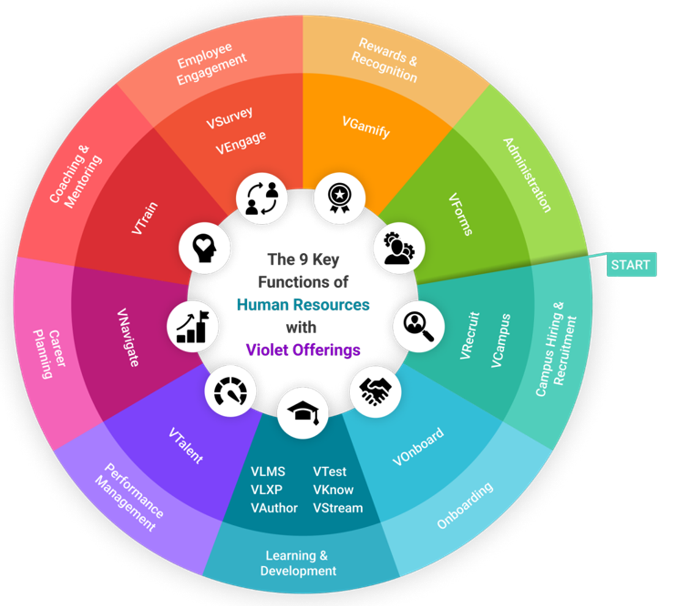
VAuthor gives Violetinfo.ai LCMS-style authoring: teams create, version and reuse AI-generated learning content, then publish it into VioletLMS for delivery and tracking.
Learning objects and single-source content
An LCMS is built around small, reusable units of content, often called learning objects. A learning object might be a single procedure, a video explanation, a scenario or a set of assessment questions. Each is tagged with metadata such as topic, audience, language, owner and review date, often following schemes like the IEEE Learning Object Metadata standard.
Courses are then assembled from these objects rather than written as one large file. When a policy changes, the team updates the affected object once, and every course that uses it can be republished with the new version. This single-source approach reduces the risk of different courses giving employees conflicting information.
LCMS vs LMS vs authoring tool
The three are related but distinct. An authoring tool is used to build content. An LCMS adds a shared repository, versioning, reuse and review workflow around that content, so many authors can work on it over time. An LMS delivers finished courses to learners, assigns them and tracks completion and scores.
In practice the boundaries blur, since many modern authoring platforms include repository and versioning features. The useful question is not the label but whether your organization can find, reuse, update and govern content at the scale it needs.
When an organization needs an LCMS
An LCMS pays off when content volume and change are high: regulated industries with frequent policy updates, organizations that deliver the same material to many roles or regions, and teams that maintain translated versions of the same course. In these settings, copying and editing separate files quickly leads to outdated and inconsistent training.
Key capabilities to evaluate include version history and rollback, approval workflows with subject-matter expert review, search and tagging, translation management and publishing to standards such as SCORM, xAPI or cmi5. VAuthor gives Violetinfo.ai LCMS-style authoring: teams create, version and reuse AI-generated learning content, then publish it into VioletLMS.
Common LCMS implementation pitfalls
The biggest risk is treating an LCMS as a file store. Without agreed rules for how content is broken into objects, tagged and reviewed, the repository becomes as hard to search as a shared drive. Define a content model and metadata standards before migrating material, and assign clear owners for each content area.
Another common issue is migrating everything at once. It is usually more effective to start with high-value, frequently updated content such as compliance or product training, prove the reuse and update benefits, and then expand.
Frequently asked questions
Is an LCMS the same as a content library?
No, a content library is usually a catalog of ready-made courses, while an LCMS is a system for creating, versioning and reusing your own content. An LCMS manages content at the component level, not just as finished courses.
Do we need both an LCMS and an LMS?
Most organizations that produce a lot of their own content benefit from both, because one manages content creation and the other manages delivery and tracking. Smaller teams may find an authoring tool with basic versioning is enough.
How does an LCMS help with compliance training?
An LCMS keeps a version history of every piece of content, so you can show which version of a policy module was live at a given time. It also makes it faster to update all affected courses when a regulation or internal policy changes.